
The Future of Warehouse Automation Technology
What’s Next in Smart Logistics
Warehouse automation technology is no longer a future concept—it’s already reshaping supply chains worldwide. But if current advancements are impressive, what comes next could be transformative. In this blog, we explore emerging trends, next-generation innovations, and real business impact shaping the future of automated warehousing.
Why the Future of Warehouse Automation Matters
Global e-commerce growth, labor shortages, and customer demand for faster delivery are pushing warehousing into a new era. Warehouse automation technology is evolving beyond simple mechanical solutions to intelligent, adaptive systems that learn, predict, and optimize in real time.
This isn’t just about robots replacing human workers; it’s about augmenting human capabilities, improving safety, and enabling agility at scale.
Key Trends Driving the Future of Warehouse Automation Technology
1. Artificial Intelligence (AI) and Machine Learning (ML)
AI will power smarter decision-making inside warehouses by:
- Predicting inventory demand
- Optimizing picking and packing routes
- Forecasting labor needs
- Reducing errors through adaptive learning
Unlike rule-based automation, AI systems learn from data and improve over time, making warehouses increasingly efficient and resilient.
2. Collaborative Robots (Cobots)
Future warehouse robots won’t be isolated behind cages—they’ll work side-by-side with humans. These cobots:
- Assist with heavy lifting.
- Support order accuracy
- Operate safely around human coworkers.
- Reduce workplace injuries
Cobots are easier to deploy and more flexible than traditional industrial robots, making automation accessible for warehouses of all sizes.
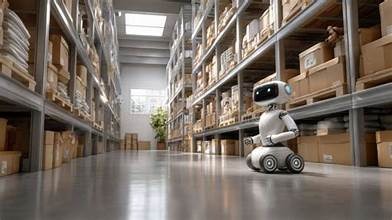
3. Autonomous Mobile Robots (AMRs)
AMRs will continue to replace rigid conveyor systems and fixed automation by:
- Navigating dynamically around obstacles
- Coordinating with fleets in real time
- Transporting goods between workstations
- Reducing warehouse bottlenecks
AMRs bring flexibility and scalability without expensive infrastructure changes.
4. Internet of Things (IoT) and Smart Sensors
IoT devices will build the foundation of connected warehouses by:
- Monitoring temperature and conditions
- Tracking asset movement in real time
- Providing predictive maintenance alerts
- Reducing loss and shrinkage
Smart sensors turn ordinary stockrooms into intelligent, data-rich environments that self-report and self-optimize.
5. Cloud-Based Warehouse Management Systems (WMS)
Modern WMS platforms are moving to the cloud to deliver:
- Real-time visibility across locations
- Seamless integration with automation hardware
- Scalable infrastructure for peak demand
- Remote configuration and analytics dashboards
Cloud-native systems break down data silos and empower rapid decision-making.
 6. 5G Connectivity in Warehouses
5G wireless technology will provide:
- Ultra-low latency for real-time control
- High-bandwidth communication for robotics
- Rapid data transmission across devices
- Reliable remote monitoring
5G will unlock next-level coordination between machines and software.
What the Next Decade Holds
🔹 Fully Autonomous Warehouses
Automation will progress from isolated tasks to holistic systems where robotics, AI, and real-time analytics manage entire workflows with minimal human intervention.
🔹 Predictive Inventory and Demand Planning
Instead of reacting after the fact, warehouses will anticipate fluctuations and prepare dynamically, reducing out-of-stock events and excess inventory.
🔹 Augmented Reality (AR) for Worker Assistance
AR glasses and displays will help workers locate items faster, reduce errors, and navigate complex picking routes.
🔹 Digital Twins and Simulation Models
Digital replicas of physical facilities will allow real-time scenario simulation, bottleneck prediction, and automation optimization without downtime.
Business Impact of Future Warehouse Automation
Automation advancements won’t just bring technical improvements—they’ll drive real business value:
🚀 Faster Turnaround Times
Orders will reach customers even quicker, improving satisfaction and loyalty.
💡 Lower Operational Costs
Automation reduces manual labor, errors, and waste—translating directly to higher margins.
📦 Better Scalability
Companies can scale operations without proportionally increasing staff or floor space.
📊 Data-Driven Decision Making
Real-time insights will replace intuition, enabling smarter strategies and tighter controls.
Challenges Ahead
Despite the promise, adopting next-gen warehouse automation comes with obstacles:
- High upfront investment for hardware and software
- Need for skilled professionals to manage smart systems.
- Cybersecurity risks linked to connected devices
- Integration complexity across legacy and modern systems
However, the long-term ROI often outweighs initial costs—especially for companies that position automation as a strategic imperative.
Final Thoughts
The future of warehouse automation technology is not just about replacing tasks with machines—it’s about building intelligent, adaptive supply chains that can thrive under uncertainty and deliver excellence at scale. As AI, robotics, IoT, and smart software converge, warehouses of tomorrow will be faster, safer, and more efficient than ever before.
For businesses ready to embrace this next wave of innovation, the time to act is now.